1 / 3
BI
尾
Naruto · Jutsu · Kanji file 021
Bijūdama — Tailed Beast Ball 尾獣玉
Pronounced bi·jū·da·ma
Native commentary for this one is still on the way — but everything above already works: the stroke order is real Japanese stroke data, the readings and meanings come straight from the dictionary database, and the 📋 button copies the exact official spelling, checked against the databooks. Go ahead — use it all, as much as you want. Want the full write-up next? Tell us below.
Speed
Breaking down the kanji
Here's what each character means — and how to write it. In Japan, following the correct stroke order is considered the key to writing kanji beautifully. Readings, stroke counts and core meanings below come directly from the KANJIDIC2 dictionary database.
2 / 3
JŪ
獣
animal · beast
3 / 3
GYOKU
玉
jewel · ball
In the works
Want the full breakdown for this one?
The native take — what each kanji echoes in real Japanese, and how this name feels to a Japanese ear — is written one entry at a time.
We write in order of demand. Your click decides the queue:
Original artwork — free to save
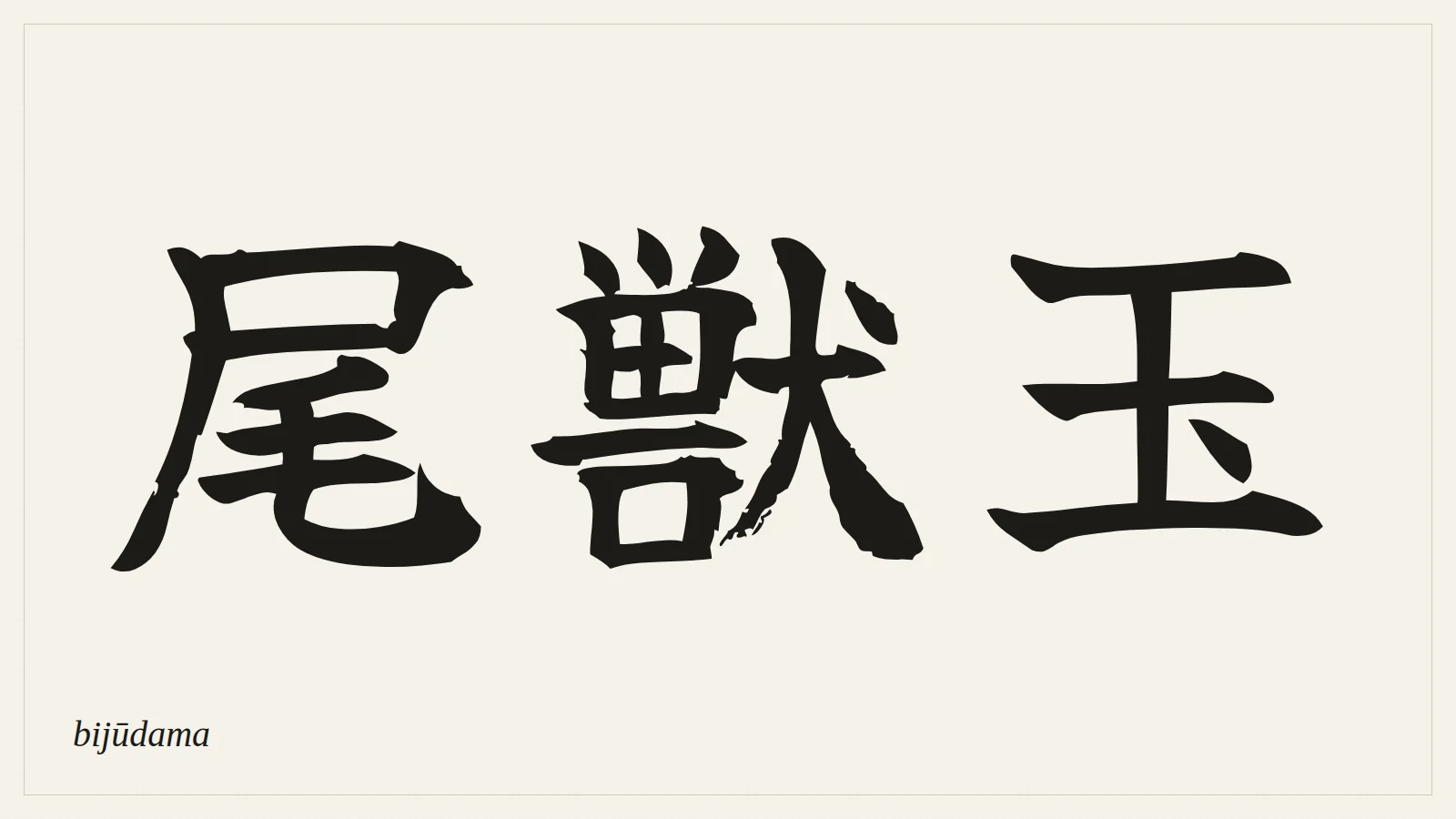
The kanji, on one sheet
A reference card we drew ourselves — the characters in Japanese brush style.
Quick answers
FAQ
How many strokes is 尾獣玉?
28 in total: 尾 is 7, 獣 is 16, 玉 is 5.
How do you pronounce Bijūdama?
Say it bi·jū·da·ma (尾獣玉). Japanese has no strong word stress: give each syllable about the same length and weight, and keep the vowels short and clear — a as in “father,” i as in “machine,” u as in “food,” e as in “met,” o as in “go.” A vowel with a bar over it (ō, ū) is long: hold it for two beats.
What characters make up Bijūdama — Tailed Beast Ball?
尾獣玉 — 尾, then 獣, then 玉. Core meanings from the KANJIDIC2 dictionary database: 尾 tail · end; 獣 animal · beast; 玉 jewel · ball.
Can I use the copied kanji anywhere?
Yes — it's standard Unicode text and works on any modern OS. One caution before you print or ink it: make sure the font is a Japanese one. Some fonts render the same characters in Chinese style, and the difference shows.