1 / 2
JU
呪
spell · curse · charm
✎ Editor’s glossa curse; a spell
Naruto · Shinobi · Kanji file 042
Pronounced ju·in
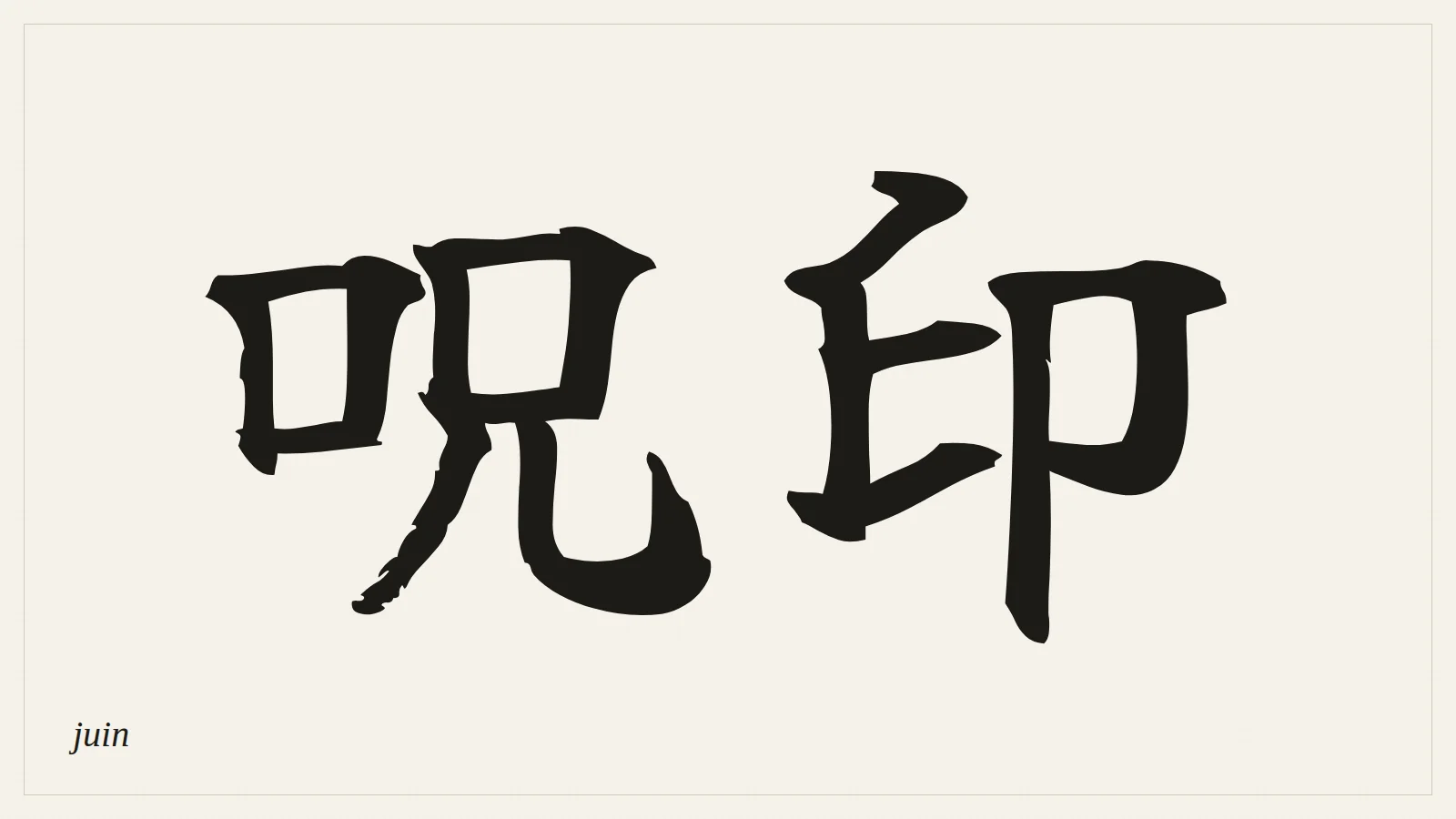
Juin (呪印) is, quite literally, a cursed seal. In games and anime it usually means a mark carved into the body — one that grants a power, or sets a curse in motion. As a Buddhist term, though, juin means something else entirely: a practice that joins a mantra or dhāraṇī — a spoken incantation — to a mudra, a seal formed with the hands. The two meanings are far apart, and a Japanese reader keeps them separate. In Naruto, Orochimaru carves cursed seals into Sasuke and Anko. And the branch family of the Hyūga clan — Neji, his father Hizashi and the rest — bear a cursed seal on the forehead, shaped like the Buddhist manji (卍).
📖 Databook: Rin no Sho, p. 194
Here's what each character means — and how to write it. In Japan, following the correct stroke order is considered the key to writing kanji beautifully. Readings, stroke counts and core meanings below come directly from the KANJIDIC2 dictionary database.
✎ Editor’s glossa curse; a spell
✎ Editor’s glossa seal; a mark
What's next
We write in order of demand. Every name and jutsu in the official databooks is listed in our Master Index — find the one you want, and tell us via the Contact page.
Original artwork — free to save
A reference card we drew ourselves — the characters in Japanese brush style.
Quick answers
14 in total: 呪 is 8, 印 is 6.
Say it ju·in (呪印). Japanese has no strong word stress: give each syllable about the same length and weight, and keep the vowels short and clear — a as in “father,” i as in “machine,” u as in “food,” e as in “met,” o as in “go.”
呪印 — 呪, then 印. Core meanings from the KANJIDIC2 dictionary database: 呪 spell · curse; 印 stamp · seal.
Yes — it's standard Unicode text and works on any modern OS. One caution before you print or ink it: make sure the font is a Japanese one. Some fonts render the same characters in Chinese style, and the difference shows.