1 / 2
FŪ
風
wind
✎ Editor's glossthe wind
Naruto · Jutsu · Kanji file 059
Pronounced fū·ton
Fūton — "Wind Style" — is a curious one, and so is Raiton. In Japan, the classical five escapes — Katon, Suiton, Mokuton, Kinton, Doton — are known as techniques for slipping away and hiding by means of something; wind is not among them, and neither is lightning. Yet it does not seem to be the author's coinage either. Digging through the holdings of Japan's National Diet Library, we found a ninjutsu manual published in 1925 — Henken Shutsubotsu Jizai: Ninjutsu Kiaijutsu Dokushinjutsu Gokui Hiden — which explains Fūton no Jutsu as ninjutsu performed by means of the wind. (We have confirmed still earlier books that explain it, too.) In Naruto, the protagonist himself carries the wind nature: Naruto's Fūton — above all the Rasenshuriken — stays a signature heavy hitter to the very end.
Here's what each character means — and how to write it. In Japan, following the correct stroke order is considered the key to writing kanji beautifully. Readings, stroke counts and core meanings below come directly from the KANJIDIC2 dictionary database. The red ✎ line is the editor's gloss — the meaning that is actually alive in this name, chosen by our editors from a Japanese kanji dictionary.
✎ Editor's glossthe wind
✎ Editor's glossto flee, to slip away — the ton of tonjutsu, the ninja arts of escape
What's next
We write in order of demand. Every name and jutsu in the official databooks is listed in our Master Index — find the one you want, and tell us via the Contact page.
The whole family
Every Fūton technique listed in the official databook index, with exact kanji and romaji. Stroke-order animations and native commentary will come to each of them — the Master Index tracks the promise.
| 風遁・圧害 | Fūton Atsugai |
| 風遁・大鎌いたちの術 | Fūton Ookamaitachinojutsu |
| 風遁・掛け網/風遁・大掛け網 | Fūton Kakeami / Fūton Ookakeami |
| 風遁・風切りの術 | Fūton Kazekirinojutsu |
| 風遁・気流乱舞 | Fūton Kiryūranbu |
| 風遁・砂散弾 | Fūton Sansandan |
| 風遁・真空玉/風遁・真空大玉 | Fūton Shinkūgyoku / Fūton Shinkūtaigyoku |
| 風遁・真空波/風遁・真空連波 | Fūton Shinkūha / Fūton Shinkūrenpa |
| 風遁・大突破 | Fūton Daitoppa“Wind Style: Great Breakthrough” |
| 風遁・風塵の術 | Fūton Fūjinnojutsu |
| 風遁・無限砂塵 大突破 | Fūton Mugensajin Daitoppa |
| 風遁・螺旋手裏剣 covered ✎ | Fūton Rasenshuriken“Wind Style: Rasenshuriken” |
| 風遁・烈風掌 | Fūton Reppūshō |
| 風遁・練空弾 | Fūton Renkūdan |
1 of 14 covered so far — requests decide the order (→ Contact)
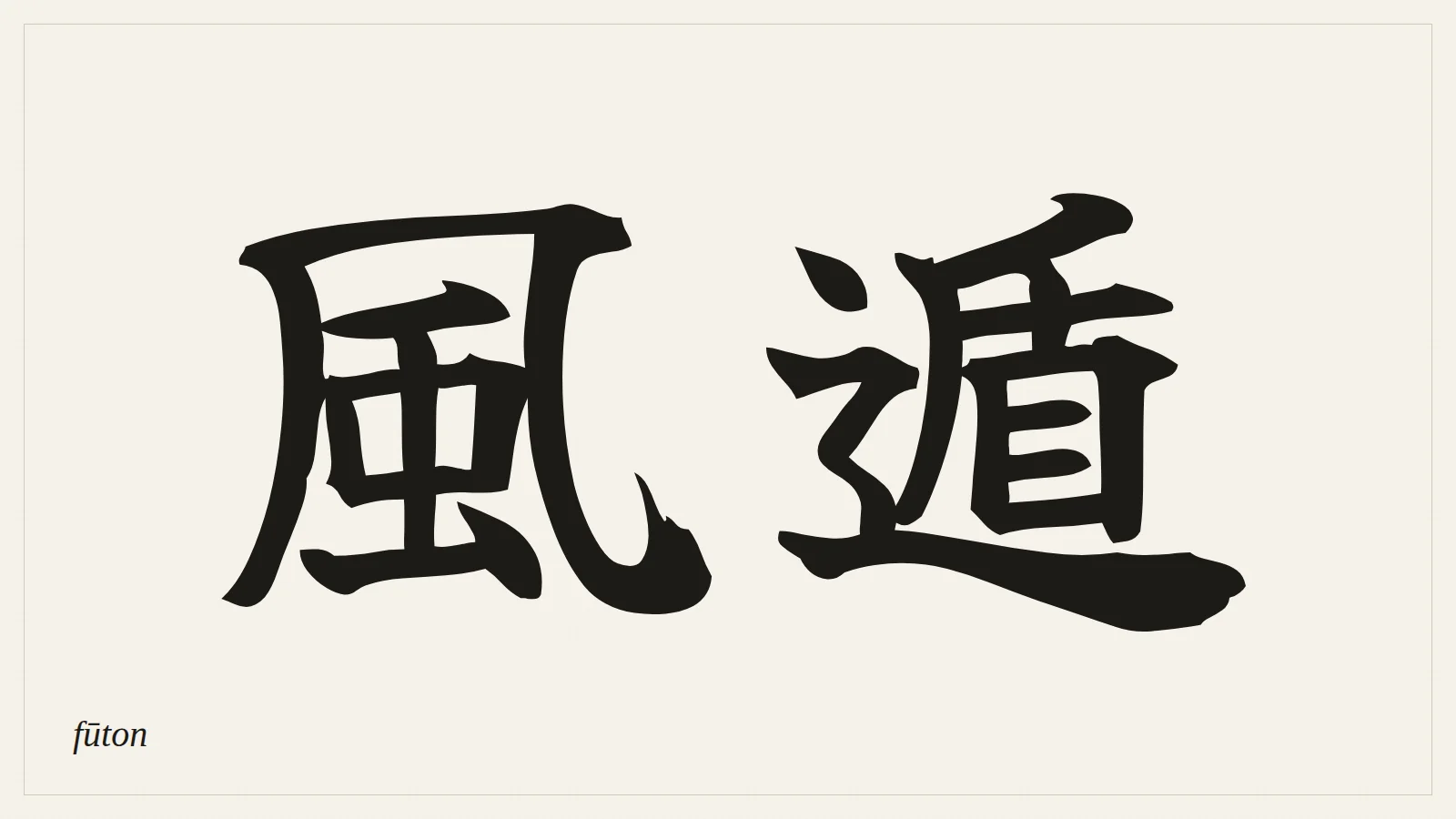
Original artwork — free to save
A reference card we drew ourselves — the characters in Japanese brush style.
Quick answers
22 in total: 風 is 9, 遁 is 13. The animation above draws every stroke in dictionary order.
Say it fū·ton (風遁). Japanese has no strong word stress: give each syllable about the same length and weight, and keep the vowels short and clear — a as in “father,” i as in “machine,” u as in “food,” e as in “met,” o as in “go.” A vowel with a bar over it (ō, ū) is long: hold it for two beats.
Fūton is written 風遁: 風 (wind); 遁 (flee). Readings and meanings come from the KANJIDIC2 dictionary database.
Yes — it's standard Unicode text and works on any modern OS. One caution before you print or ink it: make sure the font is a Japanese one. Some fonts render the same characters in Chinese style, and the difference shows.