1 / 2
GEN
幻
phantasm · vision · dream
✎ Editor’s glossto bewitch, to lead astray; a phantom
Naruto · Shinobi · Kanji file 038
Pronounced gen·ju·tsu
Genjutsu (幻術) is usually pictured as the art of showing illusions and making strange things happen. In Japan it has been told in stories since long ago: the Kamakura-period tale collection Uji Shūi Monogatari already features an illusionist, and in the yomihon novels of the Edo period, a ninja called Tobi Katō — “Katō the Flyer” — wields genjutsu. Nor is it only fiction: Kashin Koji, said to have lived in the Warring States period, is remembered as a master of illusion. In Naruto, we see genjutsu cast through the Sharingan. Jin no Sho (p. 318) describes it as a technique that, in an instant, shows its target a terrifying illusion and robs them of all freedom of movement. It lacks the spectacle of Tsukuyomi, but it puts the Sharingan’s power of hypnosis to work. One more thing: 「また幻術なのか!?」 — “Is this genjutsu again?!” (Vol. 59, Chapter 556) is a famous meme in Japan. In Gaara’s battle with the Mizukage, faced with the Mizukage’s Jōki Bōi, everyone falls into confusion — “Genjutsu again?!” “Is it genjutsu?” “No, it’s not genjutsu!” — and Japanese fans have had fun with that scene ever since.
📖 Databook: Jin no Sho, p. 318 (Genjutsu: Sharingan)
First appears: Vol. 1, Chapter 7
Here's what each character means — and how to write it. In Japan, following the correct stroke order is considered the key to writing kanji beautifully. Readings, stroke counts and core meanings below come directly from the KANJIDIC2 dictionary database.
✎ Editor’s glossto bewitch, to lead astray; a phantom
✎ Editor’s glossan art; a technique
What's next
We write in order of demand. Every name and jutsu in the official databooks is listed in our Master Index — find the one you want, and tell us via the Contact page.
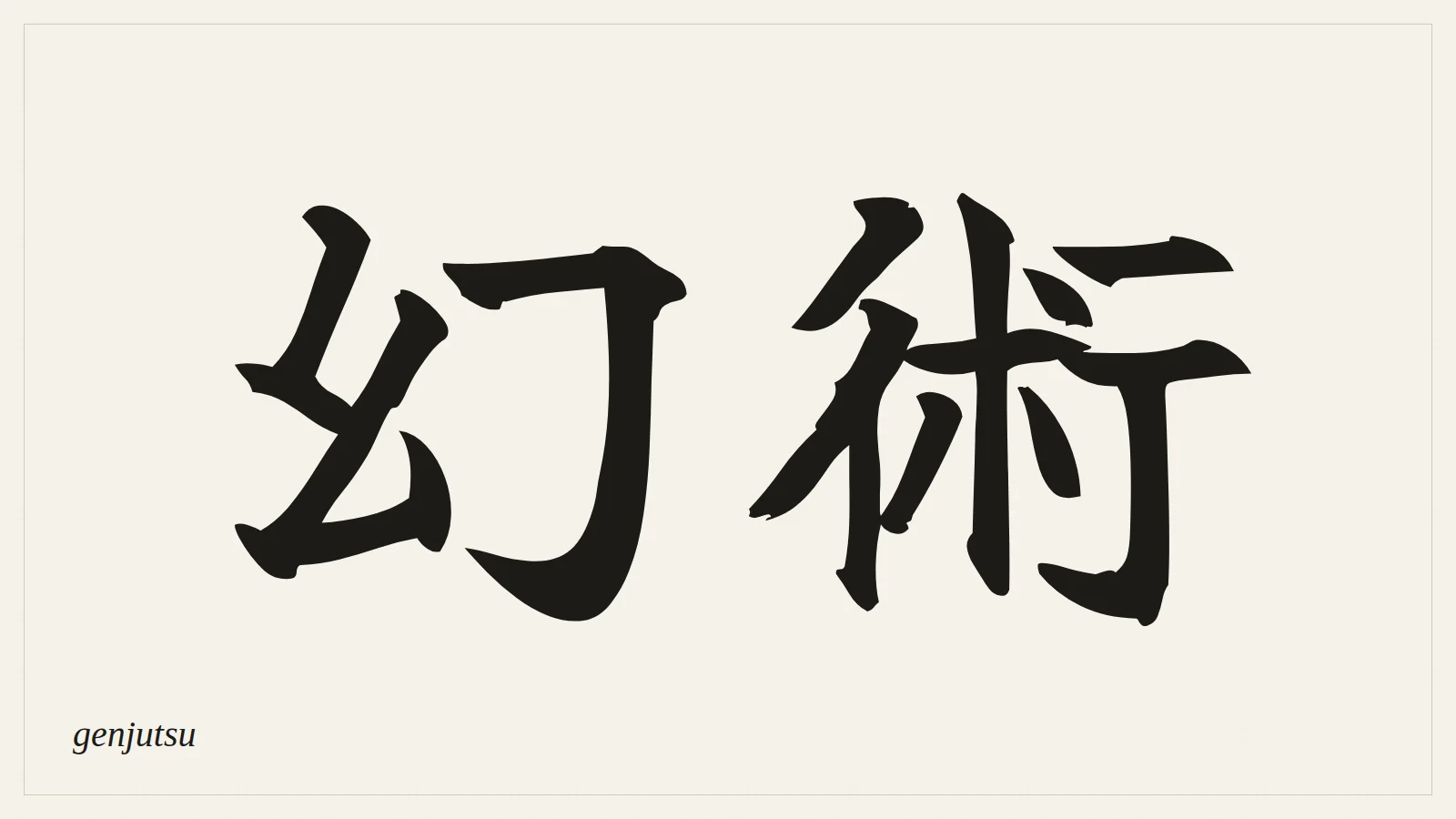
Original artwork — free to save
A reference card we drew ourselves — the characters in Japanese brush style.
Quick answers
15 in total: 幻 is 4, 術 is 11.
Say it gen·ju·tsu (幻術). Japanese has no strong word stress: give each syllable about the same length and weight, and keep the vowels short and clear — a as in “father,” i as in “machine,” u as in “food,” e as in “met,” o as in “go.”
幻術 — 幻, then 術. Core meanings from the KANJIDIC2 dictionary database: 幻 phantasm · vision; 術 art · technique.
Yes — it's standard Unicode text and works on any modern OS. One caution before you print or ink it: make sure the font is a Japanese one. Some fonts render the same characters in Chinese style, and the difference shows.