1 / 4
SEN
千
thousand
✎ Editor’s glossten times a hundred — a thousand
Naruto · Characters · Kanji file 032
Pronounced sen·ju ha·shi·ra·ma
For most Japanese, the word senju instantly calls up Senju Kannon — the Thousand-Armed Kannon, a bodhisattva worshipped in Buddhism. And 千手 means exactly that: a thousand hands. More than one name connected to NARUTO’s Senju clan traces back to Buddhism. Hashirama, on the other hand, is a word Japanese readers have never heard anywhere else. Here is what to notice: the character 柱 — pillar — carries 木, the tree, inside it. And the words that orbit Hashirama all carry 木 as well: Mokuton (Wood Style), Konohagakure — the Village Hidden in the Leaves, 木ノ葉隠れ — “the Senju clan of the forest,” Jukai Kōrin. That is surely no coincidence. And one more layer: 柱 ordinarily means the thing that holds everything up — a pillar, a mainstay — but it is also the counter word Japanese uses for counting gods.
📖 Databook: Rin no Sho, p. 116 · Tō no Sho, p. 142 · Sha no Sho, p. 160 · Jin no Sho, p. 162
First appears: Vol. 14, Chapter 118
Here's what each character means — and how to write it. In Japan, following the correct stroke order is considered the key to writing kanji beautifully. Readings, stroke counts and core meanings below come directly from the KANJIDIC2 dictionary database.
✎ Editor’s glossten times a hundred — a thousand
✎ Editor’s glossa hand; an arm
✎ Editor’s glossa pillar — the thing at the center that holds everything up; also the word Japanese uses to count gods and the spirits of the dead
✎ Editor’s glossthe space caught between two things — the in-between
What's next
We write in order of demand. Every name and jutsu in the official databooks is listed in our Master Index — find the one you want, and tell us via the Contact page.
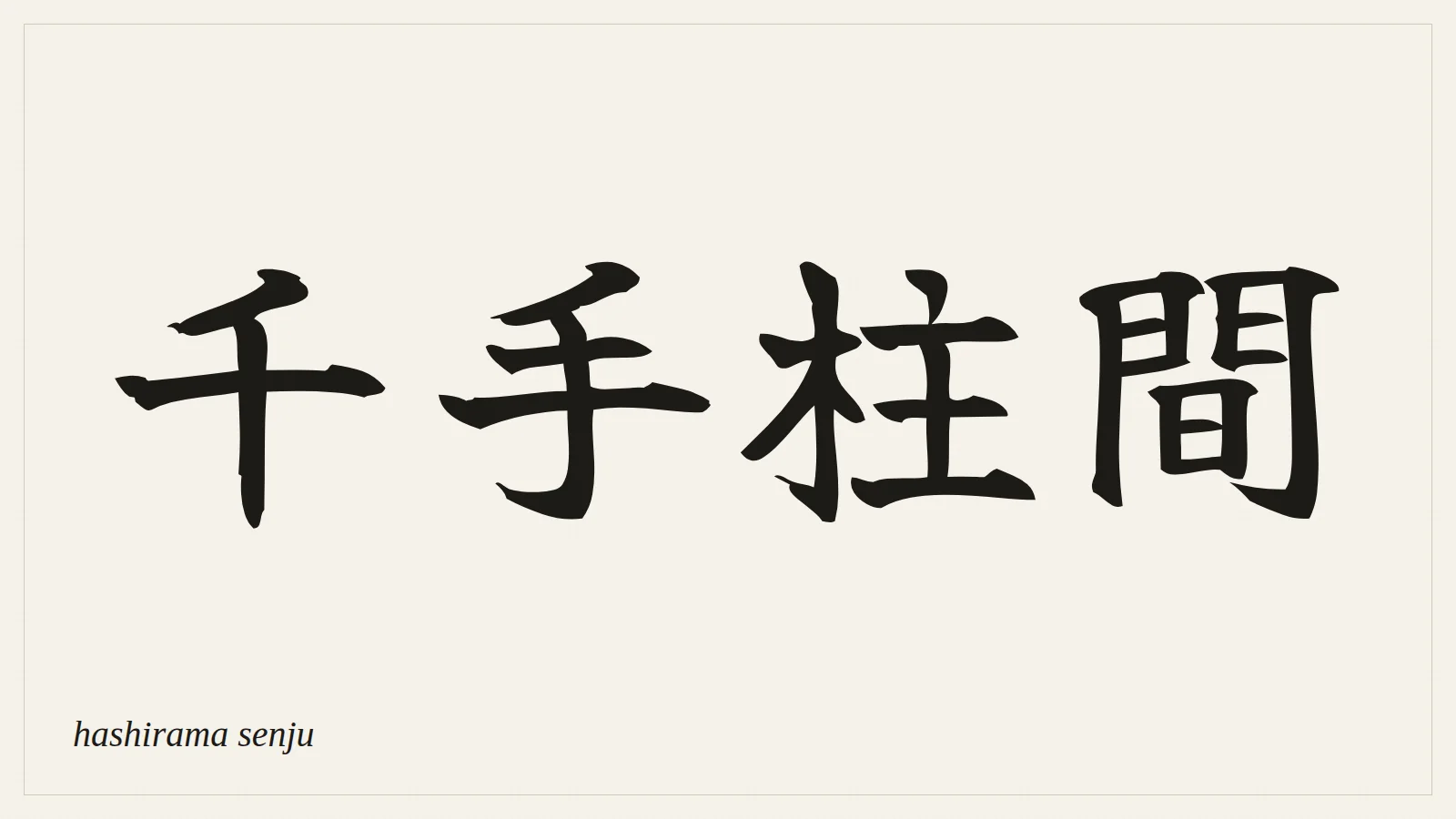
Original artwork — free to save
A reference card we drew ourselves — the characters in Japanese brush style.
Quick answers
28 in total: 千 is 3, 手 is 4, 柱 is 9, 間 is 12.
Say it sen·ju ha·shi·ra·ma (千手柱間). Japanese has no strong word stress: give each syllable about the same length and weight, and keep the vowels short and clear — a as in “father,” i as in “machine,” u as in “food,” e as in “met,” o as in “go.”
千手柱間 — 千, then 手, then 柱, then 間. Core meanings from the KANJIDIC2 dictionary database: 千 thousand; 手 hand; 柱 pillar · post; 間 interval · space.
Yes — it's standard Unicode text and works on any modern OS. One caution before you print or ink it: make sure the font is a Japanese one. Some fonts render the same characters in Chinese style, and the difference shows.