1 / 4
KETSU
血
blood
✎ Editor’s glossblood — and the ties of blood
Naruto · Shinobi · Kanji file 043
Pronounced kek·kei gen·kai
There is no Japanese word kekkei (血継) — it is the author’s own coinage. 血 means blood: kinship, a bloodline. 継 means to inherit, to carry on. And genkai (限界) is the ordinary word for a limit — the point, or the range, beyond which you cannot go. Kekkei genkai is a keyword from early in Naruto. Rin no Sho (p. 160) describes it as a technique handed down from generation to generation only through a lineage that shares the same blood. It covers dōjutsu like the Sharingan and Byakugan, nature transformations like Mokuton and Hyōton, and the Shikotsumyaku of Kimimaro of the Kaguya clan. To a Japanese eye, this four-character compound is seriously cool: a special power that only the deepest ties of blood can pass on.
📖 Databook: Rin no Sho, p. 160
First appears: Vol. 3, Chapter 25
Here's what each character means — and how to write it. In Japan, following the correct stroke order is considered the key to writing kanji beautifully. Readings, stroke counts and core meanings below come directly from the KANJIDIC2 dictionary database.
✎ Editor’s glossblood — and the ties of blood
✎ Editor’s glossto continue unbroken; to succeed to
✎ Editor’s glossa boundary; a range
✎ Editor’s glossa border; a limit
What's next
We write in order of demand. Every name and jutsu in the official databooks is listed in our Master Index — find the one you want, and tell us via the Contact page.
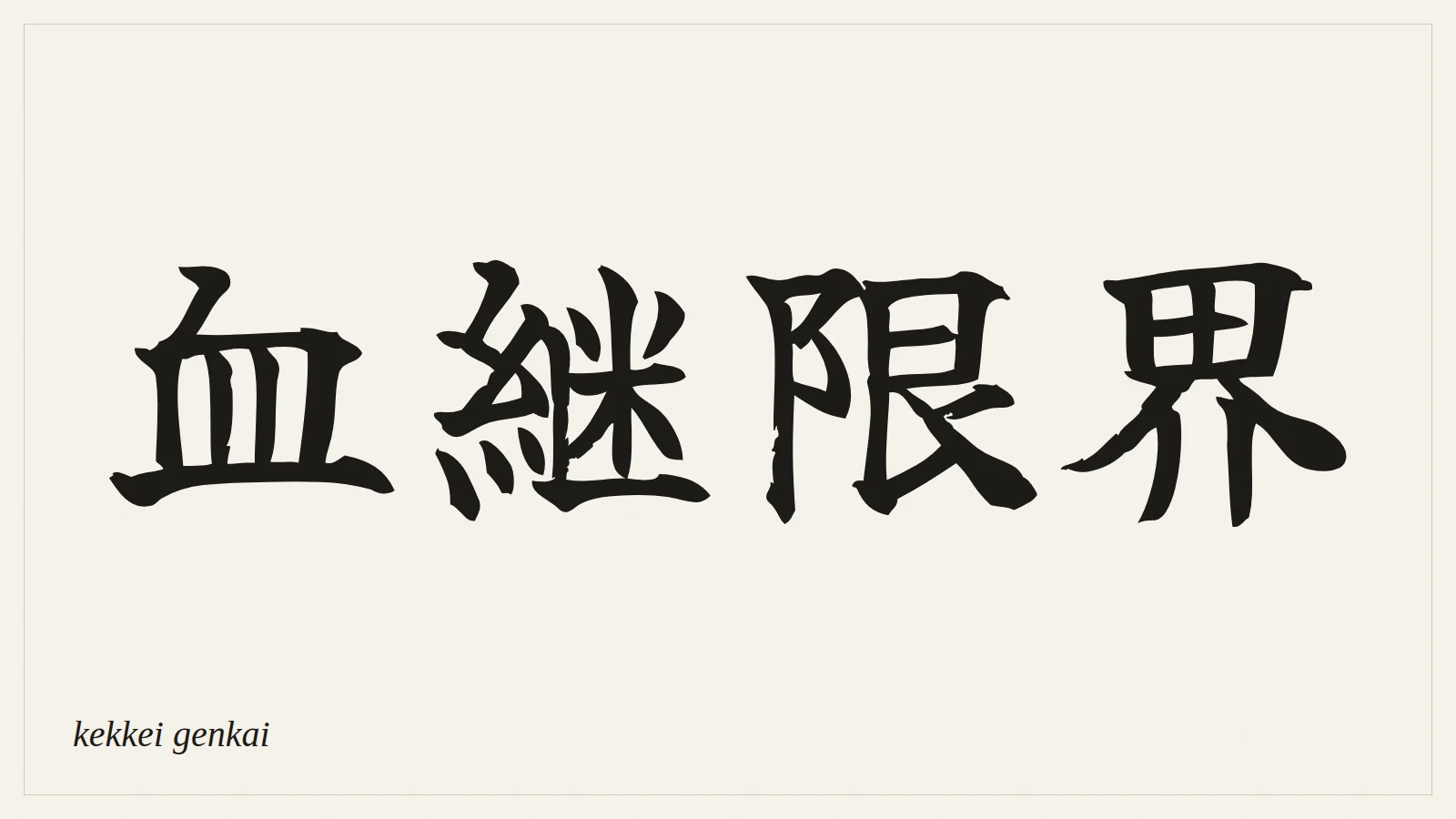
Original artwork — free to save
A reference card we drew ourselves — the characters in Japanese brush style.
Quick answers
37 in total: 血 is 6, 継 is 13, 限 is 9, 界 is 9.
Say it kek·kei gen·kai (血継限界). Japanese has no strong word stress: give each syllable about the same length and weight, and keep the vowels short and clear — a as in “father,” i as in “machine,” u as in “food,” e as in “met,” o as in “go.”
血継限界 — 血, then 継, then 限, then 界. Core meanings from the KANJIDIC2 dictionary database: 血 blood; 継 inherit · succeed; 限 limit · restrict; 界 world · boundary.
Yes — it's standard Unicode text and works on any modern OS. One caution before you print or ink it: make sure the font is a Japanese one. Some fonts render the same characters in Chinese style, and the difference shows.