1 / 2
KŌ
口
mouth
✎ Editor’s glossthe mouth
Naruto · Shinobi · Kanji file 041
Pronounced ku·chi·yo·se
In Japanese, kuchiyose (口寄せ) is the rite of calling a spirit of the dead into your own body and letting it speak its will through your mouth. Its most famous practitioners are the itako — female spirit mediums of Japan’s Tōhoku region, above all Aomori Prefecture. In Naruto, the defining image is the Legendary Sannin calling forth their great serpent, toad and slug — but plenty of other characters show off summonings of their own. Rin no Sho (p. 182) explains it as a kind of space–time ninjutsu: it calls a creature you have bound by a blood contract to wherever you want it, whenever you want it.
📖 Databook: Rin no Sho, p. 182
Here's what each character means — and how to write it. In Japan, following the correct stroke order is considered the key to writing kanji beautifully. Readings, stroke counts and core meanings below come directly from the KANJIDIC2 dictionary database.
✎ Editor’s glossthe mouth
✎ Editor’s glossto lodge in — as a spirit takes up residence in a body
What's next
We write in order of demand. Every name and jutsu in the official databooks is listed in our Master Index — find the one you want, and tell us via the Contact page.
Original artwork — free to save
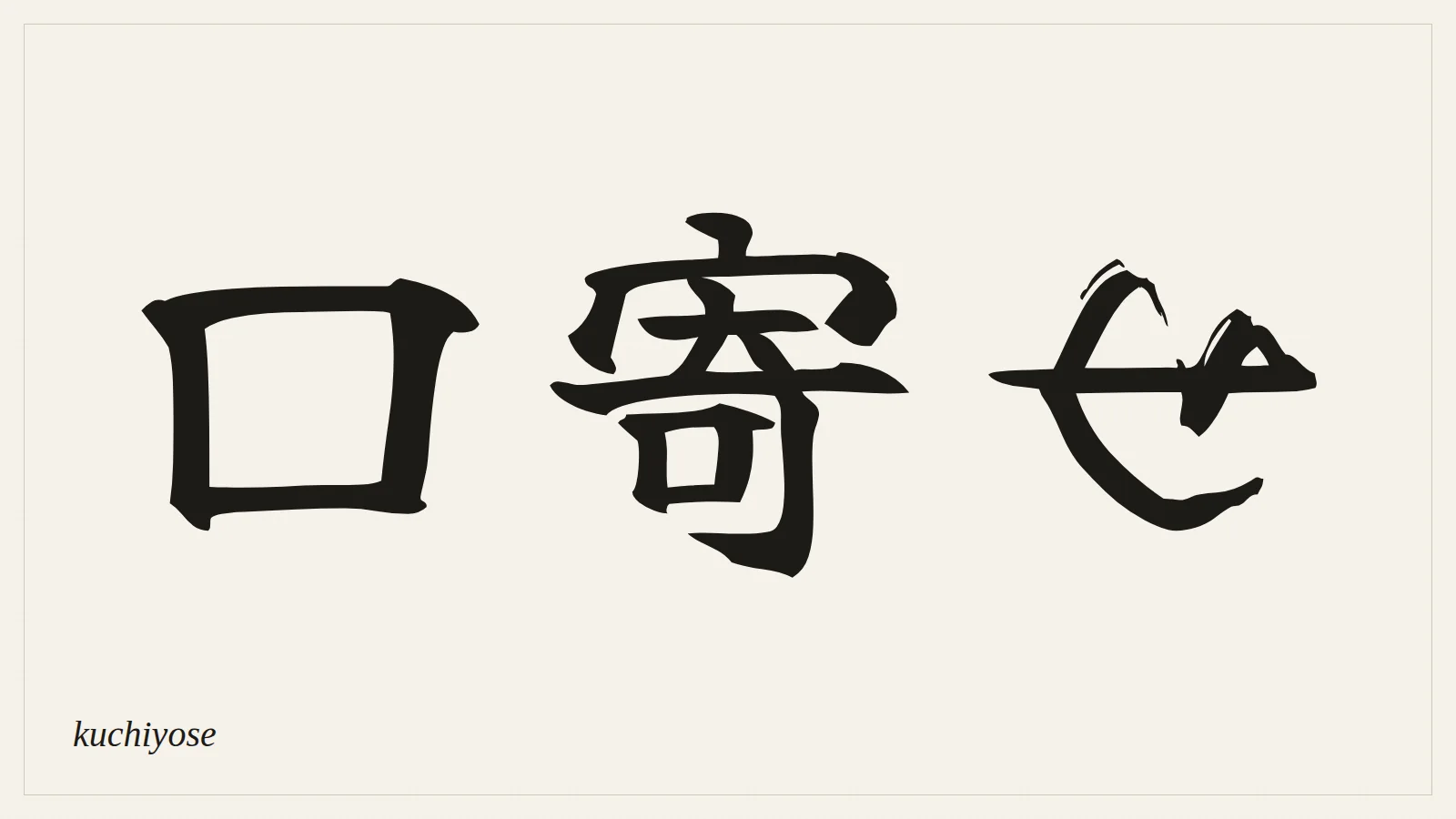
A reference card we drew ourselves — the characters in Japanese brush style.
Quick answers
17 in total: 口 is 3, 寄 is 11, せ is 3.
Say it ku·chi·yo·se (口寄せ). Japanese has no strong word stress: give each syllable about the same length and weight, and keep the vowels short and clear — a as in “father,” i as in “machine,” u as in “food,” e as in “met,” o as in “go.”
口寄せ — 口, then 寄, then せ. Core meanings from the KANJIDIC2 dictionary database: 口 mouth; 寄 draw near · stop in.
Yes — it's standard Unicode text and works on any modern OS. One caution before you print or ink it: make sure the font is a Japanese one. Some fonts render the same characters in Chinese style, and the difference shows.