1 / 4
SHIN
神
gods · mind · soul
✎ Editor's glossa god — a power beyond human understanding
Naruto · Jutsu · Kanji file 023
Pronounced shin·ra ten·sei
Shinra Tensei is, we believe, the author's own coinage — and a beautifully engineered one. To a Japanese ear, the sound shinra instantly summons the four-character idiom shinra banshō (森羅万象), "all things in creation" — but look closely: the kanji here are different. Likewise tensei echoes rinne tensei (輪廻転生), the transmigration of souls — again with different characters. Borrowed sounds, altered characters — and out of that trick comes a name of imposing, ceremonial presence on the page. We Japanese are helpless before a four-character compound that looks this good. Shinra Tensei is also one of a pair: its twin is Banshō Ten'in (万象天引). The former commands repulsion, the latter attraction — and both carry a dignity of lettering worthy of their user, Pain. That the author could coin such names, meaning exactly what the techniques do — hats off, honestly.
📖 Databook: Jin no Sho, p. 260
Here's what each character means — and how to write it. In Japan, following the correct stroke order is considered the key to writing kanji beautifully. Readings, stroke counts and core meanings below come directly from the KANJIDIC2 dictionary database.
✎ Editor's glossa god — a power beyond human understanding
✎ Editor's glossto catch as with a net; to stand dense as a net's mesh
✎ Editor's glosswhere the gods reside — nature beyond human reach
✎ Editor's glossto go forth; to strike down
What's next
We write in order of demand. Every name and jutsu in the official databooks is listed in our Master Index — find the one you want, and tell us via the Contact page.
Original artwork — free to save
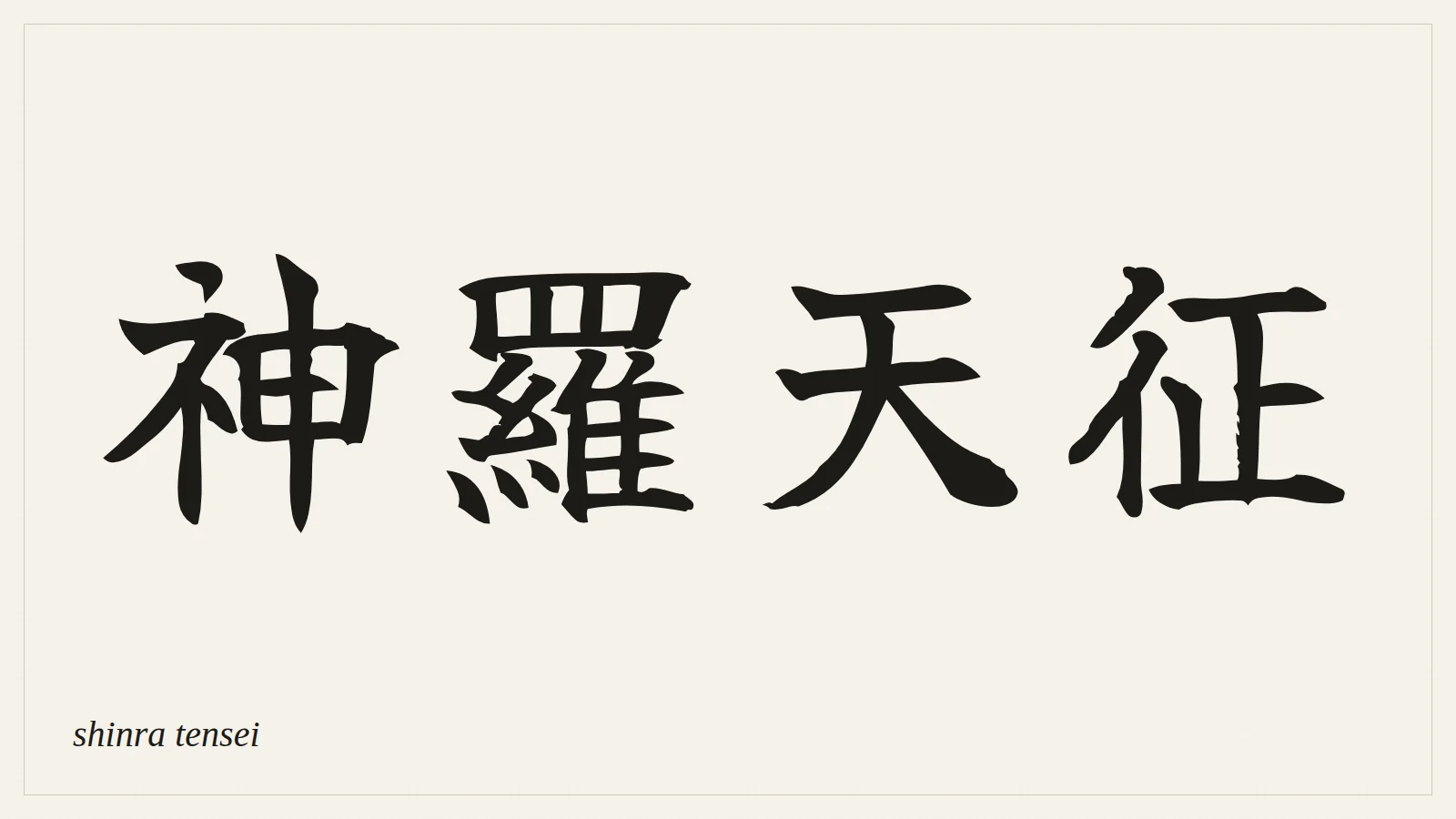
A reference card we drew ourselves — the characters in Japanese brush style.
Quick answers
40 in total: 神 is 9, 羅 is 19, 天 is 4, 征 is 8.
Say it shin·ra ten·sei (神羅天征). Japanese has no strong word stress: give each syllable about the same length and weight, and keep the vowels short and clear — a as in “father,” i as in “machine,” u as in “food,” e as in “met,” o as in “go.”
神羅天征 — 神, then 羅, then 天, then 征. Core meanings from the KANJIDIC2 dictionary database: 神 gods · mind; 羅 gauze · thin silk; 天 heavens · sky; 征 subjugate · attack the rebellious.
Yes — it's standard Unicode text and works on any modern OS. One caution before you print or ink it: make sure the font is a Japanese one. Some fonts render the same characters in Chinese style, and the difference shows.