1 / 3
JŪ
十
ten
✎ Editor's glossten
Naruto · Weapons · Kanji file 036
Pronounced to·tsu·ka no tsu·ru·gi
The Totsuka Blade (十拳剣) is a sword of Japanese mythology — though not the name of one particular blade. Totsuka means "ten fists long": it is a title, and several gods wield a totsuka blade of their own. In the myths, Izanagi used one to cut down the fire god; Susanoo used one to slay the eight-headed serpent Yamata no Orochi. In Naruto, Itachi's Susanoo holds the Totsuka Blade in its right hand and the Yata Mirror in its left. The official databook Sha no Sho explains it as one of the Kusanagi swords — a blade that itself carries a sealing jutsu. Its other name is Sakegari no Tachi, the "sake-cutting longsword": those it pierces are drawn into a genjutsu world of drunken dreams. And who ended up sealed inside it? You know the one — the man who stands for the snake.
📖 Databook: Sha no Sho, p. 338
Here's what each character means — and how to write it. In Japan, following the correct stroke order is considered the key to writing kanji beautifully. Readings, stroke counts and core meanings below come directly from the KANJIDIC2 dictionary database. The red ✎ line is the editor's gloss — the meaning that is actually alive in this name, chosen by our editors from a Japanese kanji dictionary.
✎ Editor's glossten
✎ Editor's glossfist
✎ Editor's glosssword
What's next
We write in order of demand. Every name and jutsu in the official databooks is listed in our Master Index — find the one you want, and tell us via the Contact page.
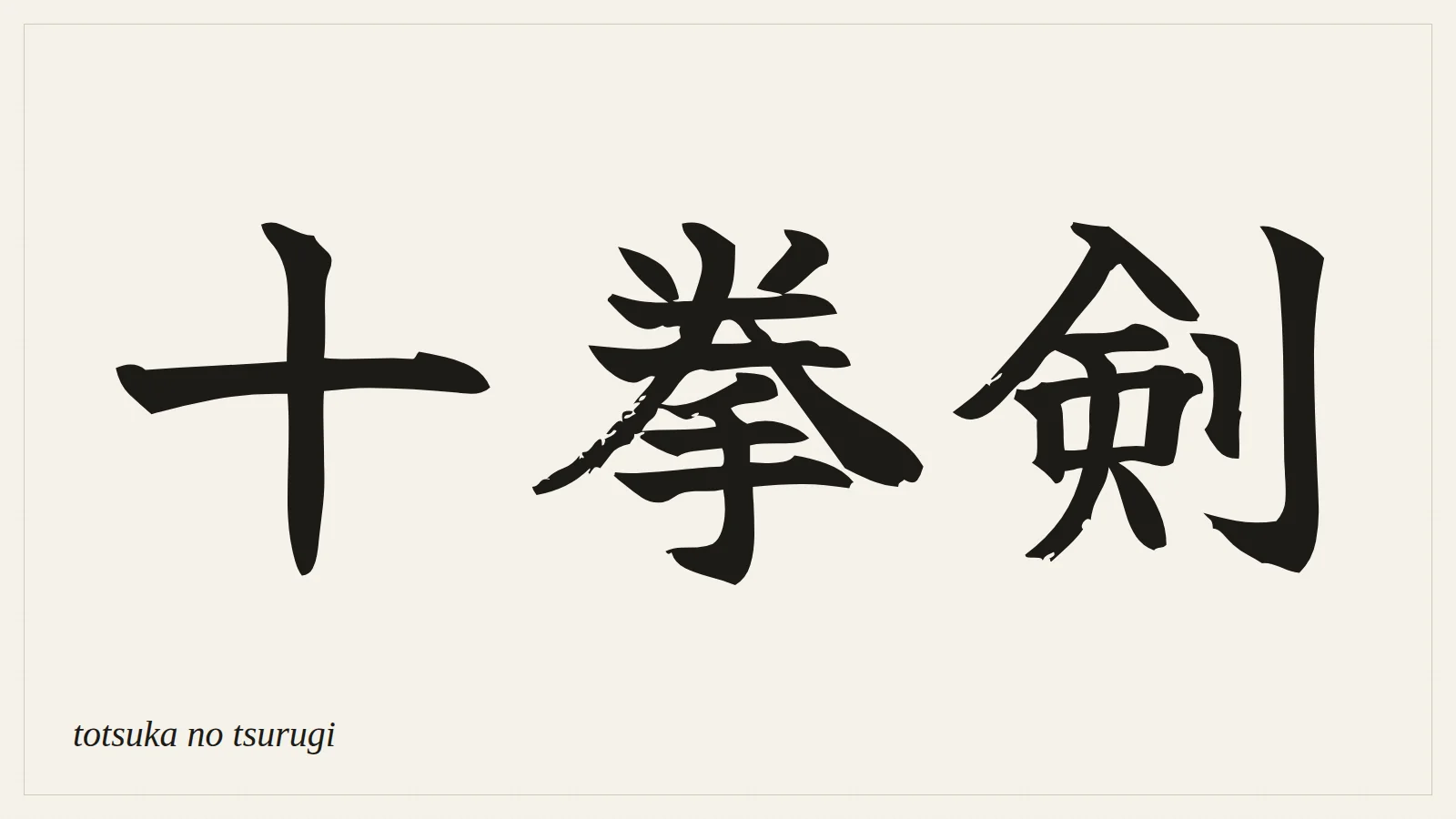
Original artwork — free to save
A reference card we drew ourselves — the characters in Japanese brush style.
Quick answers
22 in total: 十 is 2, 拳 is 10, 剣 is 10.
Say it to·tsu·ka no tsu·ru·gi (十拳剣). Japanese has no strong word stress: give each syllable about the same length and weight, and keep the vowels short and clear — a as in “father,” i as in “machine,” u as in “food,” e as in “met,” o as in “go.”
十拳剣 — 十, then 拳, then 剣. Core meanings from the KANJIDIC2 dictionary database: 十 ten; 拳 fist; 剣 sabre · sword.
Yes — it's standard Unicode text and works on any modern OS. One caution before you print or ink it: make sure the font is a Japanese one. Some fonts render the same characters in Chinese style, and the difference shows.